Le parcours
Routes & stages
The route changes every year, but its shape does not. Here is how the Tour is built — and where the 2027 race begins.
2026 route map
The official parcours
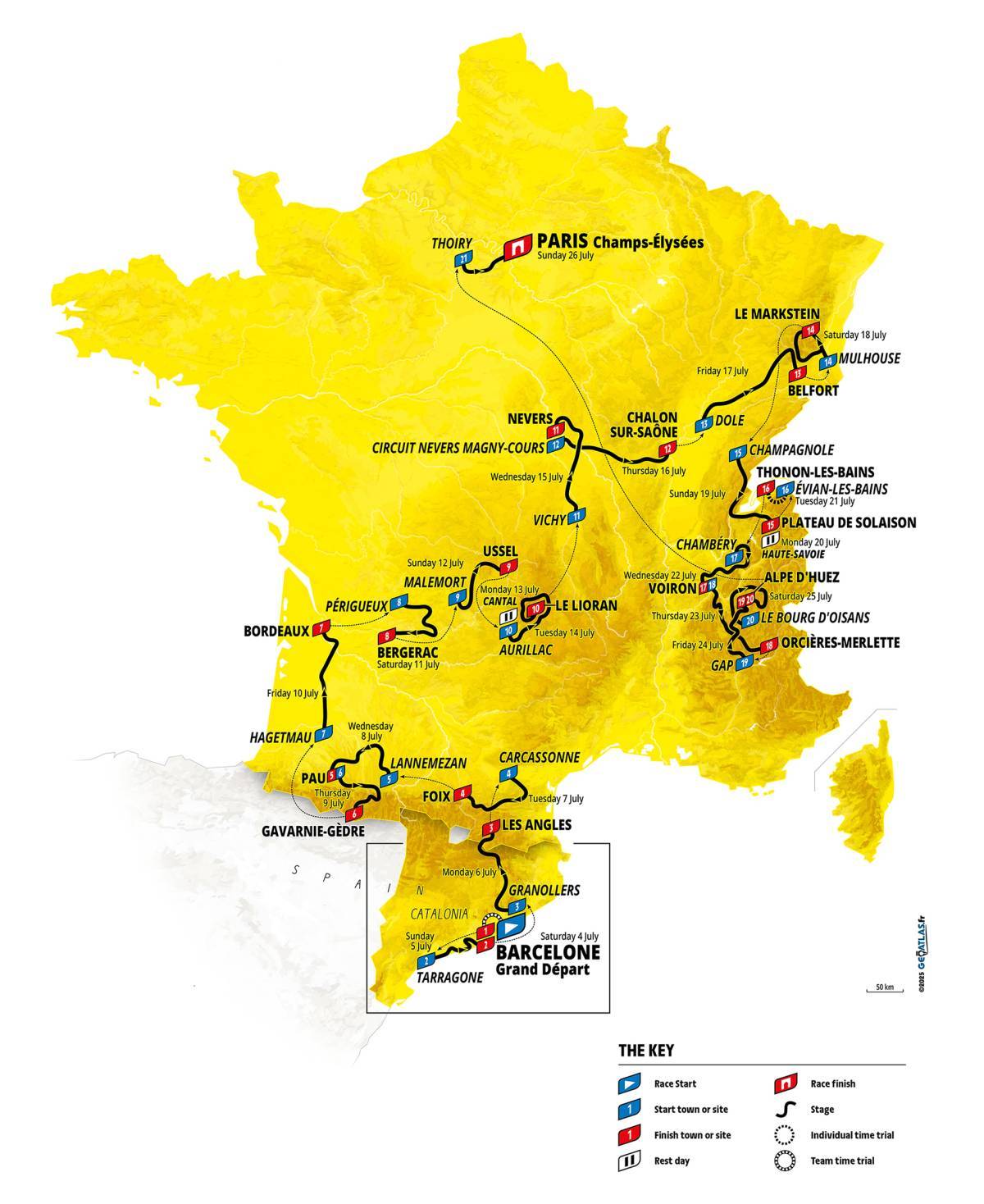
The 2026 Tour de France parcours — Grand Départ, mountain stages, time trials and the road to Paris.
Structure
Anatomy of a Tour route
Grand Départ
The opening weekend, often hosted abroad — Yorkshire 2014, Copenhagen 2022, Florence 2024, Edinburgh 2027.
Week one
Flat and rolling stages for the sprinters, plus crosswinds, cobbles or a short time trial to shake up the GC.
Week two
The first mountain range — Pyrenees or Massif Central — where the contenders show their hand.
Week three
The high Alps and a decisive time trial. Gaps that looked small become minutes.
Final stage
A ceremonial ride into Paris, ending on the Champs-Élysées — with Montmartre climbs added in recent editions.
Stage types
What the riders face
Flat stage
150–200km controlled by sprinters' teams, ending in a bunch gallop at 70km/h.
Hilly / punchy
Repeated short climbs suit breakaways and classics riders.
Mountain stage
Three to five categorised cols, often finishing at altitude.
Individual time trial
Solo against the clock — where minutes are made in the GC.
Team time trial
Occasionally used; the squad's time is taken on a set rider.
Rest days
Two per Tour, usually after weeks one and two, often with a transfer.
Grands Départs
Where recent Tours started
Cols
The climbs that decide it
Col du Tourmalet
2,115 mPyrenees
Used more than 85 times — the Tour's most-climbed giant.
Alpe d'Huez
1,850 mAlps
21 numbered hairpins, each named after a stage winner.
Mont Ventoux
1,910 mProvence
The bald 'Giant of Provence', where Tom Simpson died in 1967.
Col du Galibier
2,642 mAlps
The Tour's spiritual high point since 1911.
Col d'Izoard
2,360 mAlps
The lunar Casse Déserte, scene of Coppi and Bobet legends.
Col de la Loze
2,304 mAlps
A modern brute with ramps above 20%.